Mastering the Distance Formula: A Complete Guide (2D & 3D)
Whether you're plotting a course on a map, developing a 3D video game, or solving complex physics problems, the distance formula is one of the most essential tools in your mathematical toolkit. This comprehensive guide covers everything from basic 2D calculations to advanced 3D spatial analysis, real-world applications in engineering and data science, and step-by-step practice problems to sharpen your skills.
What is the Distance Formula?
The distance formula is a mathematical equation used to determine the length of the straight-line segment connecting two points in a Cartesian coordinate system. It is a direct application of the Pythagorean Theorem, which states that in a right-angled triangle, the square of the hypotenuse is equal to the sum of the squares of the other two sides (\(a^2 + b^2 = c^2\)).
By treating the horizontal and vertical distances between two points as the legs of a right triangle, we can calculate the direct path (hypotenuse) between them. This concept is fundamental not just in geometry class, but in fields as diverse as astrophysics, computer graphics, and navigation systems.
The 2D Distance Formula
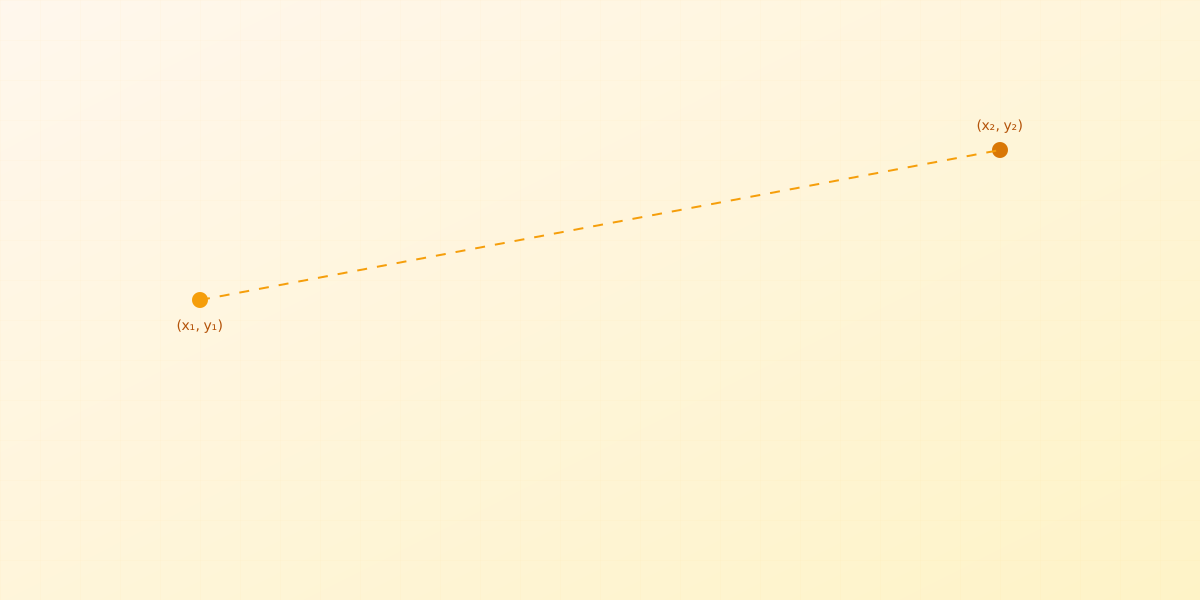
In a two-dimensional plane (like a sheet of paper or a computer screen), points are defined by an x-coordinate (horizontal position) and a y-coordinate (vertical position). given two points \( A(x_1, y_1) \) and \( B(x_2, y_2) \), the distance \( d \) is calculated as:
The 3D Distance Formula
Our world isn't flat, and neither are many of the problems we need to solve. In three-dimensional space, we add a third coordinate, \( z \) (depth or height). The beauty of the distance formula is its scalability—we simply add the squared difference of the z-coordinates under the radical:
Distance Formula Examples
Let's walk through several examples to see exactly how the formula works in practice. We'll start simple and move to more complex scenarios.
Example 1: Basic 2D Calculation
Problem: Find the distance between Point A (2, 3) and Point B (10, 9).
Solution:
- Identify coordinates: \( x_1=2, y_1=3 \) and \( x_2=10, y_2=9 \).
- Find differences:
- \( \Delta x = 10 - 2 = 8 \)
- \( \Delta y = 9 - 3 = 6 \)
- Square differences: \( 8^2 = 64 \), \( 6^2 = 36 \).
- Sum squares: \( 64 + 36 = 100 \).
- Take square root: \( \sqrt{100} = 10 \).
Answer: The distance is 10 units.
Example 2: Working with Negative Coordinates
Problem: Calculate the distance between Point P (-3, -4) and Point Q (2, 8).
Solution:
- Identify coordinates: \( x_1=-3, y_1=-4 \) and \( x_2=2, y_2=8 \).
- Calculate difference in x: \( 2 - (-3) = 2 + 3 = 5 \).
- Calculate difference in y: \( 8 - (-4) = 8 + 4 = 12 \).
- Square and sum: \( 5^2 + 12^2 = 25 + 144 = 169 \).
- Root: \( \sqrt{169} = 13 \).
Answer: The distance is 13 units.
Example 3: 3D Space (Physics Context)
Problem: A drone moves from position A (1, 5, 2) to position B (3, 2, 8). How far did it travel?
Solution:
Using the 3D formula:
$$ d = \sqrt{(3-1)^2 + (2-5)^2 + (8-2)^2} $$
$$ d = \sqrt{(2)^2 + (-3)^2 + (6)^2} $$
$$ d = \sqrt{4 + 9 + 36} = \sqrt{49} = 7 $$
Answer: The drone traveled 7 units.
Distance Formula Practice Problems
Test your understanding with these practice problems. Try to solve them manually before checking the answer with our calculator above!
Problem 1: Diagonal of a Rectangle
Points A (0, 0) and C (6, 8) form the diagonal of a rectangle. What is the length of the diagonal?
Show Answer
Distance = 10 units. \( \sqrt{6^2 + 8^2} = \sqrt{36+64} = \sqrt{100} = 10 \).
Problem 2: The "Nearest Neighbor"
You are situated at Origin (0,0). Which point is closer? A(5, 5) or B(7, 1)?
Show Answer
Distance to A: \( \sqrt{5^2 + 5^2} = \sqrt{50} \approx 7.07 \)
Distance to B: \( \sqrt{7^2 + 1^2} = \sqrt{50} \approx 7.07 \)
Answer: They are equidistant!
Advanced Applications: Beyond the Classroom
While often introduced in geometry class, distance calculation algorithms power much of the modern technology we rely on.
🗺️ GPS & Navigation
Every time you ask Google Maps for directions, it's performing millions of distance calculations. While earth is a sphere (requiring the Haversine formula), local navigation often uses linear distance approximations.
🎮 Game Design
"Collision detection" relies on distance. If the distance between a bullet's coordinates and a character's coordinates is less than the character's radius, a hit is registered.
🏗️ Civil Engineering
Surveyors calculate the distance between landmarks to determine property lines, road lengths, and cable requirements efficiently.
📡 Telecommunications
Determining signal strength often depends on the distance between a cell tower and the receiver. Engineers minimize "dead zones" by optimizing these distances.
Explore More Calculation Tools
If you found this tool helpful, check out our other calculators designed to simplify complex math and physics problems:
Frequently Asked Questions
Can distance ever be negative?
No. In Euclidean geometry, distance is a scalar quantity representing magnitude. Even if you move "backwards" on a graph, the distance traveled is positive. The formula ensures this because squaring any real number results in a positive value.
What is Manhattan Distance?
The standard formula calculates "Euclidean Distance" (as the crow flies). "Manhattan Distance" (or Taxicab geometry) measures distance assuming you can only move along grid lines (like city blocks). The formula is \( |x_2 - x_1| + |y_2 - y_1| \).
Does order of points matter?
No. Because \((A - B)^2\) is equal to \((B - A)^2\), it does not matter which point defines \( (x_1, y_1) \) and which defines \( (x_2, y_2) \). The result will be identical.